

Book Review: Rediscovering Nisar Aziz Butt’s Wandered the Traveller
Book Review: Rediscovering Nisar Aziz Butt’s Wandered the Traveller
 Joydeep Dasgupta
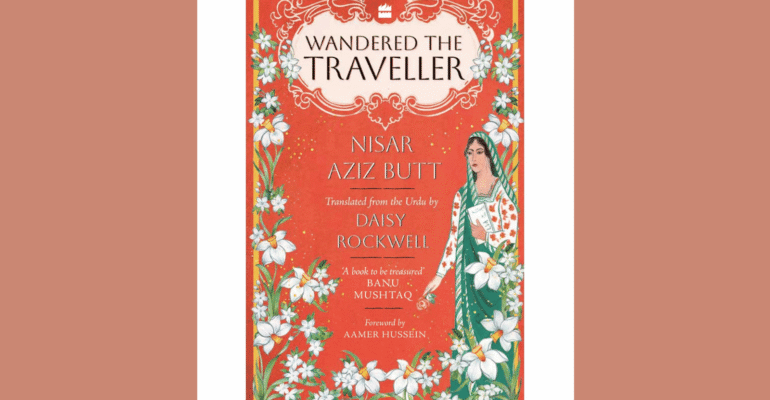
 Some books arrive as new publications; others arrive as discoveries. Nisar Aziz Butt’s Wandered the Traveller belongs to the latter category. First published in Urdu in 1955, the novel has now been brought to English readers for the first time by Harper Collins in a translation by Daisy Rockwell, offering a fresh encounter with a remarkable, largely overlooked voice in South Asian literature.
At the centre of the novel is Afgar, a brilliant young Pashtun woman whose journey takes her from an orphaned and turbulent childhood to the cloistered environment of a mountain sanatorium and eventually towards the possibility of pursuing a doctorate at Cambridge. Her journey is not simply geographical. It is also an intellectual and emotional passage through questions of knowledge, freedom, ambition, love and the limits imposed by the world around her.
What makes Afgar particularly compelling is that she is not presented merely as a victim of social restrictions. She is fiercely intelligent, intellectually restless and conscious of her own standards. Her encounters with men are filtered through that demanding intellect, and the novel places her desire for love alongside an equally powerful desire for knowledge and independence. In this sense, Butt’s heroine feels strikingly contemporary despite the novel having been written more than seven decades ago.
The historical distance between the novel’s first publication and its present English-language readership is important. Butt was born in 1927 in Mardan, near Peshawar, and was an exceptional student of mathematics before illness interrupted her university education. After recovering from tuberculosis, she returned to complete her MA and later taught mathematics at Punjab University. She began writing Nagari Nagari Phira Musafir, the Urdu title of Wandered the Traveller, while still in college.
That biography lends an additional dimension to the novel’s preoccupation with a woman pursuing intellectual possibilities in a society where those possibilities were not easily available. Butt subsequently wrote three more major novels and a memoir, and was part of the literary world that included writers such as Qurratulain Hyder, Khadija Mastur and Altaf Fatima. Yet, remarkably, her work had never previously been translated into English.
This is where Daisy Rockwell’s translation becomes particularly significant. Rockwell is not approaching the novel simply as an archival exercise. The publisher’s material indicates that she was drawn to Butt’s “labyrinthine sentences”, philosophical reflections and descriptions of the natural landscape of Pakistan’s Northwest Frontier region. Her task, therefore, is to carry across not merely the narrative but also the intellectual texture and cultural cadence of the original.
Translation is always an act of negotiation, particularly when a work carries the linguistic, cultural and historical density of Urdu. With Wandered the Traveller, that task becomes even more consequential because English readers are encountering Butt’s work for the first time. Rockwell’s reputation as an accomplished Hindi-Urdu translator adds weight to the project; she is an International Booker Prize winner and has received several major awards for literary translation.
The novel’s most enduring quality may ultimately be the tension within Afgar herself. She wants knowledge but also intimacy; independence but also love. She inhabits a world that places limits on her, yet she refuses to allow those limits to define the boundaries of her imagination. That makes the novel less a conventional story of emancipation and more an exploration of the complicated interior life of an intellectually ambitious woman.
There is also something significant about the landscape through which Afgar’s story unfolds. The mountains, the sanatorium and the wider Northwest Frontier setting are not merely a backdrop. Butt’s writing, as described by Rockwell, combines philosophical reflection with vivid descriptions of the region’s natural beauty. The physical landscape consequently appears to have an important relationship with the protagonist’s inner world.
The novel’s rediscovery also raises a larger question about literary history: how many important voices remain outside the canon because they were written in languages that do not readily cross into the dominant circuits of global publishing? Wandered the Traveller offers one answer. Its journey from Urdu publication in 1955 to an English translation in 2026 is itself a reminder that literary recognition can arrive decades after a work has been written.
The publisher describes the book as a portrait of “female ambition and desire” from a part of the world that has been underrepresented in the literary canon. That description captures much of what makes the novel culturally interesting. But its importance need not rest solely on its recovery as a forgotten woman’s voice. The story of Afgar, with its intellectual ambition, emotional complexity and search for freedom, gives the novel a relevance that extends beyond its historical circumstances.
Wandered the Traveller therefore deserves attention not simply because it is an old novel newly translated, but because it brings into contemporary English-language reading a literary imagination that has remained largely inaccessible to that readership. Nisar Aziz Butt’s Afgar emerges as a character whose hunger for knowledge and freedom does not feel confined to the 1950s.


