

The Orange Economy and the Age of the Creative Machine
The Orange Economy and the Age of the Creative Machine

 News Sense Team
 By Debashis Sen, IAS (Retd)
When ChatGPT was released in November 2022, I was Chairman of the New Town Kolkata Development Authority and leading the New Town Smart City initiative, and I believed I had a reasonable understanding of what artificial intelligence could do for a city. We used it to detect people not wearing masks during the pandemic, and we taught our CCTV cameras to geofence Eco Park so an alert reached us whenever anyone walked too close to the great lake. Those were useful applications, but they were not using Large Language Models (LLMs) simply because these were not yet invented then. The AI applications were all about watching and warning. Nothing had prepared me for a technology that could read a single sentence and answer with a painting, a melody or a script.
In early 2023,LLMs began reaching India, and I spent many months studying them with my IT team at NKDA. I took several online courses. I sensed this was an opportunity our state could not afford to lose. I bought software such as Adobe Firefly, Dall-E and Midjourney and started experimenting. I still remember the thrill of typing a few words and watching a finished image appear on the screen. I had visited art galleries in many parts of the world, and in Amsterdam I was particularly impressed by the MOCO Museum, which devotes an entire section to AI art. So, producing pictures of my own through patient experiments with prompts gave me a joy unlike anything I had felt before.
Where the colour comes from
The phrase Orange Economy has a gentle history. Iván Duque and Felipe Buitrago coined it in a book published by the Inter-American Development Bank in 2013, and they chose orange because the pigment once adorned the tombs of the pharaohs and has long stood for culture, creativity, and identity.
India embraced the idea with energy, and at the WAVES summit in Mumbai in May 2025, Prime Minister Narendra Modi spoke of the dawn of the Orange Economy in our country and described its three pillars as content, creativity and culture. The government backed that vision with an Indian Institute of Creative Technology in Mumbai to prepare the next generation in Animation, Visual Effects, Gaming, Comics, and Extended Reality (AVGC-XR) skilling.
What the numbers are telling us
Artificial intelligence has become the engine of this economy, and the figures are remarkable. The streaming company Deezer reported in April 2026 that 44 per cent of the new music uploaded to its platform each day was fully generated by AI, and by June the share had crossed half on its busiest days. In a survey across eight countries, 97 per cent of listeners could not tell AI music from human music in a blind test.
Books tell a similar story, since research reported this year suggests that about half the titles sold on Amazon in 2025 contained some AI-generated text, although a separate study of books that authors publish themselves found that those written heavily by AI earned only about eleven per cent of the revenue. Volume has arrived in abundance, and value has not yet followed, which is a lesson I will return to.
Stories from the frontier
In Britain, the studio Particle 6 has announced a feature film called Misaligned with an AI-created performer named Tilly Norwood in the lead. Although the project is still in early development, its founder, Eline van der Velden, has said it will bring traditional directors, writers and editors together with AI specialists, because the technology can support serious storytelling only when it is accompanied by a great deal of human craft and judgement.
During my recent visit to Tokyo as part of a business delegation led by the CII, I saw a company called AI Avatar sign football legends such as Ronaldinho so fans can talk with an interactive avatar of their hero. Sports lovers are willing to pay for that experience. Closer to home, I know real estate developers are setting aside their digital publicity agencies in favour of young startups that produce strikingly attractive Reels with AI. Enterprising teams here in Kolkata are already making documentary films at a fraction of the earlier cost.
The pace of change should make us sit up, because the tools grow stronger roughly every six months, and the model behind ChatGPT advanced from its fifth generation in August 2025 to GPT‑6 Astra in September 2026. Gemini, Claude and Grok have all become faster and more capable alongside it.
The human hand
All of this leaves many artists, singers, and authors wondering where they will stand, and my answer is hopeful. A run-of-the-mill composition can now be produced in minutes by Gemini, ChatGPT, Claude or Grok, but a masterpiece will always depend on the human being behind the prompt, on that person’s taste, memory, sorrow and joy. A random video is not the objective; art is. So, human creativity will and must remain at the top.
Bengal is exceptionally well placed for this age, home to Tagore and Satyajit Ray, the patuas of Kalighat, and the artisans of Kumartuli who turn clay into Durga every autumn. A land with such a cultural base can become a world leader if it learns to combine its heritage with these new tools. To ignore the technology would be to let a great opportunity pass, and that is why I began holding exhibitions such as “AI Art on Canvas” at the Academy of Fine Arts, followed by shows at Gaganendra Art Gallery, ITC Sonar, Chitrakoot Art Gallery and elsewhere, for I have always believed that seeing is believing.
A call to every citizen
I would like every reader, whether painter, writer, musician, student, entrepreneur or retired professional, to open one of these AI tools this week and spend an hour experimenting with it, and then to use what one learns to tell a story that only she can tell, whether through a film, a song, a book or an image. The Orange Economy will reward those who bring their own imagination to the machine, and it will pass by those who wait to be convinced.
My next AI art exhibition at the Gaganendra Art Gallery is planned in November 2026, and it will be presented alongside a ‘Hello AI !’ exhibition that helps one understand how AI is shaping our lives, society and information systems. It will be a great opportunity to see how human imagination and the creative machine can work together.
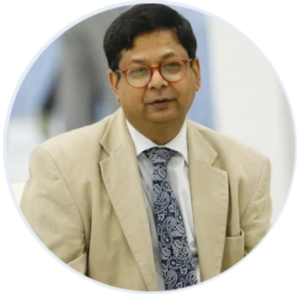 Shri Debashis Sen, IAS (Retd.), is a distinguished Civil Servant known for his leadership in public administration, urban development and governance. He has played a significant role in shaping Kolkata’s urban and institutional landscape through decades of administrative experience. Now an AI Educator and AI Art Activist.


